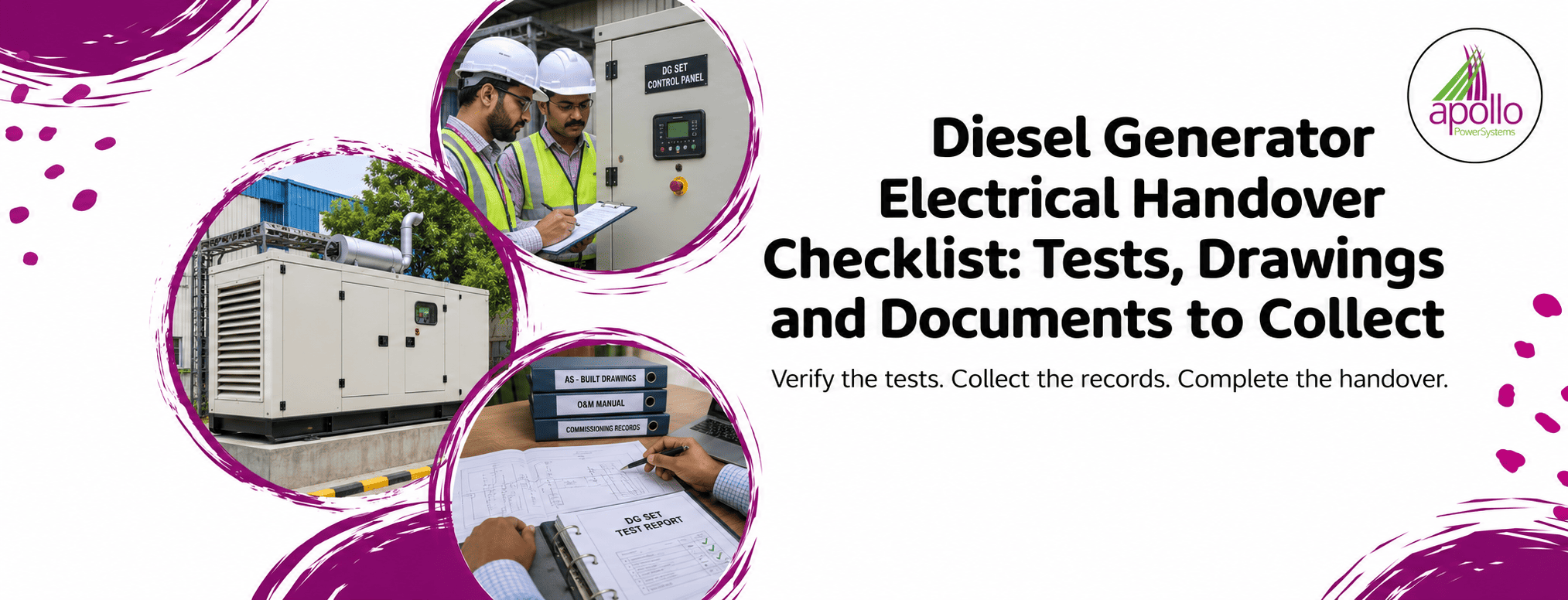
Before accepting a diesel generator installation, an owner should verify that the set performs as specified and that the handover records will support operation and future maintenance. Apollo Power Systems provides DG installation, testing and commissioning for commercial and industrial facilities, backed by more than 30 years of electrical project experience. This checklist helps facility managers, project teams and owner’s engineers review the tests, drawings, approvals and operating records for a new DG set.
Confirm that alarms, protections and automatic transfer work as designed. Resolve critical defects and obtain authorised sign-off. Requirements depend on the project specification, generator configuration, manufacturer instructions and applicable approvals. Use this checklist with the approved project documents and acceptance criteria for the site.
Start with a physical and documentary review. A generator that runs well on day one can still cause problems later if records are missing. Check the installation first, then confirm the paperwork supports it.
Name the person or team responsible for each stage, and write down who handles inspection, commissioning and final acceptance. Clear ownership prevents disputes at sign-off.
On a DG project, the electrical contractor, generator supplier, commissioning team and owner may have different responsibilities. Set out who leads each test, who witnesses it, which acceptance criteria apply, and who signs off or submits approval records. Apollo Power Systems’ electrical contracting team provides generator installation, testing and commissioning for commercial and industrial facilities. Confirm the handover scope and approval responsibilities with the owner and project team before commissioning; applicable licences and approvals depend on location and project scope.
For a generator installation and commissioning project, match each report to the approved scope. The test plan should reflect the generator, control panel and transfer arrangement, with acceptance criteria set before testing starts. Ask for written results, not verbal assurances.
Each report should identify the DG set and equipment tested, the test method, operating conditions, instruments used (including calibration reference where applicable), approved acceptance criteria, readings, witness and result. Record any corrective work, its owner and date; attach the retest to the original report so the audit trail remains complete.
A generator may start perfectly with no load. Real problems often appear only under electrical demand. That is why generator load testing matters at handover.
Testing under load checks that the set holds voltage and frequency, runs within temperature limits, and responds correctly as demand changes. When site demand is too low or unavailable, a load bank is the usual way to apply a controlled load.
| Item | What to look for |
|---|---|
| Load stages | The agreed steps, applied in order |
| Test duration | The period set by project and manufacturer requirements |
| Operating readings | Voltage, frequency, current, oil pressure and temperatures |
| Observed faults | Alarms, trips, leaks or abnormal noise |
| Result | Pass or fail against the approved criteria |
There is no single load-test duration or set of acceptance limits that applies to every generator. Follow the approved project specification and the manufacturer’s procedure. Record the load steps, stabilisation periods, duration, readings and any deviations, then compare the results with the stated criteria. If a load bank is used, identify it and record its rating and test configuration.
Gather the full package before final payment or sign-off. Missing drawings cost time during future faults and upgrades. Confirm that every required document is included before closing the handover. Use the checklist below: Click a status box to select ✓ Received or ✗ Missing. Select ☐ Not marked to reset.
| Item | Required record | Status |
|---|---|---|
| Single-line diagram | As-built version |
|
| Wiring diagrams | Control and power circuits |
|
| Cable schedule | Sizes, routes and tag numbers |
|
| Earthing layout | Final installed arrangement |
|
| Commissioning report | Signed by witnesses |
|
| Load-test report | Load steps, readings and duration (site load or load bank) |
|
| Operating manual | Site-specific version |
|
| Warranty details | Start date, terms and contacts |
|
| Approval records | Where applicable |
|
Design drawings show the intended arrangement; as-built drawings should reflect the final installation. Check each drawing’s revision, date and approval status, and reconcile it with equipment labels and cable identification on site. This gives maintenance teams a usable reference when tracing a circuit or planning a change.
Sign-off confirms that you accept the system, so take time over it. First, close open items, then confirm readiness, and then finalise the records.
Handover also marks the shift from project commissioning to routine operation. The maintenance plan should tell site teams who checks the generator, when service is due, where records are kept and whom to contact when a fault occurs.
Set service intervals using the generator and engine manufacturer’s instructions, operating hours, site conditions and the maintenance contract. Document the service scope, responsible party, escalation contacts and required records. Apollo Power Systems provides annual maintenance contracts and preventive maintenance for generator sets from 3 kVA to 4000 kVA. Apollo’s generator service network includes more than 25 engineers, and the company has maintained gensets with a combined capacity of over 450 MW. Before handover, confirm the generator models and capacity, included service visits, parts coverage, response times, exclusions and reporting frequency in the AMC. DG service and maintenance.
Apollo Power Systems supports generator service with ERP-based equipment histories, breakdown-call management and online health-check reports. The AMC should state how site staff receive these records, how faults are escalated and how recommendations are tracked through closure. Apollo Power Systems product-support services. For a new generator project or service agreement, facility teams can share the generator rating, make and model, site location and expected service coverage with Apollo Power Systems to discuss scope.
Commissioning proves the system works through testing. Handover transfers the system, records, and responsibility to the owner.
Collect electrical checks, start-and-stop tests, alarm and protection tests, transfer tests, and the load-test report.
A no-load run confirms starting and basic operation, but it does not demonstrate performance under the specified electrical demand. Use the approved site-load or load-bank procedure when required by the project specification or manufacturer.
Follow the sign-off roles in the contract and commissioning plan. They commonly include the commissioning engineer, installing contractor and owner’s authorised representative; include the consultant or other witness where the project documents require it.
Include the single-line diagram, wiring diagrams, cable schedule and earthing layout.
Record the failed test, affected function, risk controls, corrective-action owner and retest criteria. Repeat the test after the correction and retain both records. Acceptance should follow the contract’s process, with safety-critical and protection-related issues resolved before the system is accepted for normal operation.
Whether provisional handover is allowed depends on the contract and the owner’s acceptance process. If permitted, list every open item with an owner, due date and closure evidence. Do not treat unresolved safety-critical or protection-related defects as accepted; follow the site’s safety controls and contract requirements.


Follow Us


© Copyright 2026. All rights are reserved with Apollo Power Systems.


